
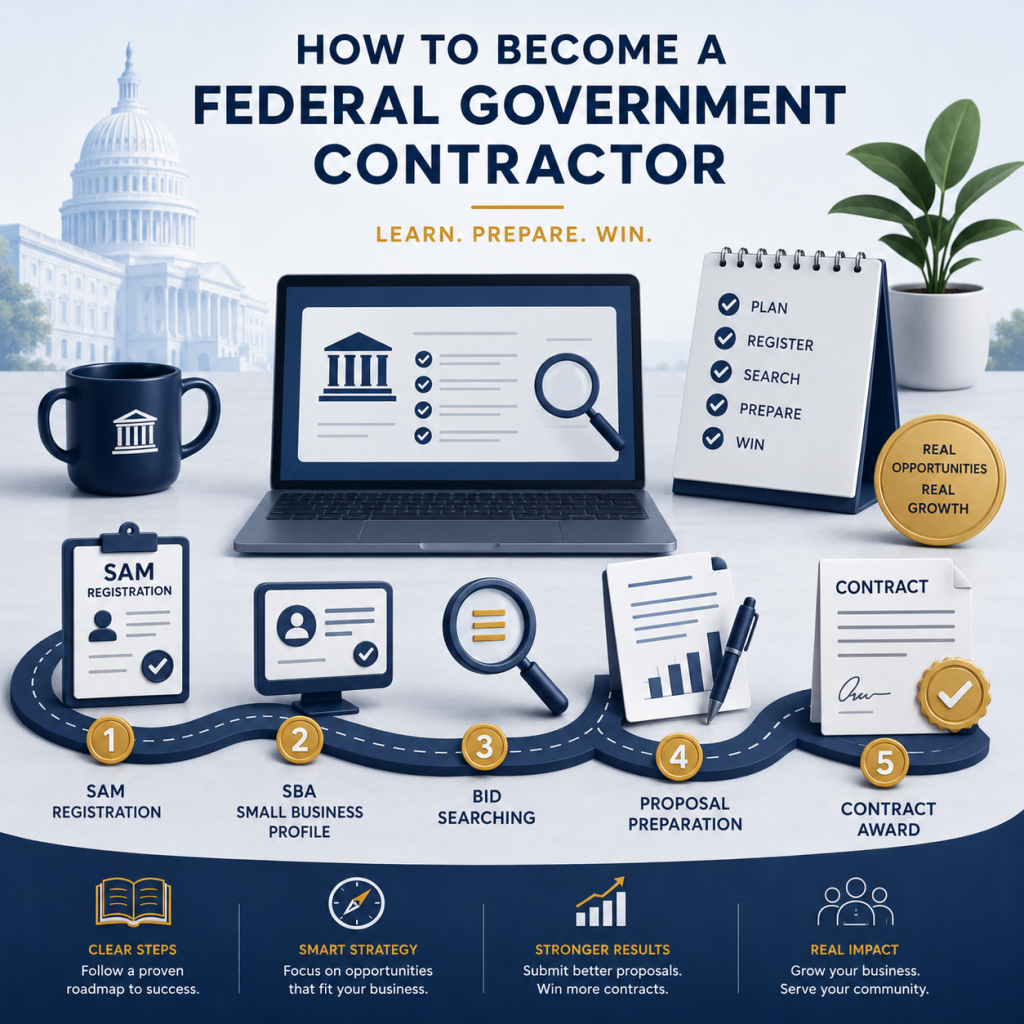
The federal government purchases products and services from businesses of nearly every size and industry.
However, becoming a federal contractor requires more than creating an account and searching for bids. Your company must be properly registered, accurately classified, easy for buyers to find, and prepared to meet federal solicitation and performance requirements.
The following steps provide a practical roadmap for entering the federal marketplace.
Federal contracting can create valuable opportunities, but not every business is ready to perform a government contract.
Before registering, evaluate whether your company has:
Government agencies expect contractors to deliver exactly what was promised, when it was promised, and according to the contract’s terms.
Your business must be classified accurately.
NAICS codes identify the industries in which your company operates. They are also used to determine whether your business qualifies as small under SBA size standards.
The definition of a small business varies by NAICS code and may be based on average annual revenue or number of employees. Affiliated companies may also need to be included in the size calculation.
Product and Service Codes, or PSCs, describe what the federal government is purchasing. These codes can be used to research previous awards and identify agencies buying similar products or services.
Selecting inaccurate or overly broad codes can make your business harder to find and may create problems when representing its small-business status.
Businesses seeking direct federal contract awards generally need an active SAM.gov registration.
During registration, the business provides information concerning:
A Unique Entity ID is assigned through SAM.gov. U.S. entities may also complete CAGE code assignment or validation as part of the process.
SAM.gov registration is free. Businesses may complete it themselves or hire a professional registration service to assist with classification, documentation, representations, and validation issues.
An active SAM registration must generally be renewed every 365 days. Businesses can update their information between renewals when necessary.
After SAM registration, eligible small businesses should complete and optimize their profile in the SBA’s Small Business Search, or SBS.
SBS was formerly known as the Dynamic Small Business Search, or DSBS. Existing business profiles were migrated to the updated SBS platform.
Government agencies and prime contractors use SBS to search for small businesses by:
Contracting officers are required to use SBS as part of federal small-business market research. The database can help officials decide whether an acquisition should be set aside for small businesses or a particular socioeconomic program.
Your SBS profile should include:
A weak or incomplete profile can cause your business to be overlooked—even when it is fully qualified.
A capabilities statement is a concise document introducing your business to government buyers and prime contractors.
It commonly includes:
A capabilities statement is not required to register in SAM or apply for an SBA certification, but it is one of the most commonly used marketing documents in government contracting.
It can be sent to small-business specialists, used during matchmaking events, provided to prime contractors, and included with certain responses.
Do not begin by bidding on every opportunity containing one of your keywords.
Start with market research.
Identify:
SAM.gov provides access to federal contract opportunities and award information. Businesses can search active opportunities, follow notices, and save searches for future monitoring.
The SBA also recommends researching the federal marketplace, using SBS, and taking advantage of federal contracting resources before pursuing contracts.
Qualified businesses may benefit from one or more SBA contracting programs:
These programs may provide access to set-aside contracts, sole-source opportunities, business-development assistance, or other competitive advantages.
Certification should follow an eligibility and market assessment. A certification has limited value when the agencies buying your services rarely use that program.
Applications for these programs are currently managed through MySBA Certifications.
Government contracting is not limited to responding to publicly posted solicitations.
Small businesses should also connect with:
Your goal is to understand upcoming requirements before the final solicitation is released.
Prime contractors can be particularly valuable to newer federal vendors. Subcontracting may help a business gain relevant experience, establish past performance, and understand federal contract administration before serving as the direct prime contractor.
A solicitation may contain dozens or hundreds of pages of instructions, clauses, attachments, and technical requirements.
Before bidding, evaluate:
A compliant proposal follows the instructions exactly. A persuasive proposal also demonstrates a clear understanding of the requirement, presents a low-risk performance approach, and supports its claims with relevant evidence.
govCERTS provides proposal-writing assistance for federal solicitations, as well as longer-term positioning and bidding support.
Federal contractor responsibilities continue after registration and award.
Businesses should regularly review:
Allowing a SAM registration to expire can affect award eligibility and payment processing.
New contractors frequently make the following mistakes:
How much does it cost to register in SAM.gov?
SAM.gov does not charge a fee for entity registration. Businesses may choose to pay a third-party provider for professional registration, classification, validation, or compliance assistance.
Can I bid before my SAM registration is active?
You can research opportunities, but an active SAM registration is generally required to receive a federal contract award. Some solicitations may require active registration by the offer deadline.
How long does it take to become a federal contractor?
The timeline depends on entity validation, registration accuracy, certification applications, and business readiness. Becoming registered can occur relatively quickly, but developing a competitive federal sales pipeline usually requires continued research, outreach, and bidding.
Will the government contact me after I register?
Registration alone rarely produces consistent leads. Buyers are more likely to find and evaluate businesses with complete profiles, relevant capabilities, targeted outreach, and accurate industry information.
govCERTS assists small businesses with:
The goal is not simply to activate your registration. It is to build a complete government-contracting foundation that helps your company become visible, identify opportunities, and compete responsibly.
Register correctly. Position strategically. Bid with purpose.
| Cookie | Duration | Description |
|---|---|---|
| cookielawinfo-checkbox-analytics | 11 months | This cookie is set by GDPR Cookie Consent plugin. The cookie is used to store the user consent for the cookies in the category "Analytics". |
| cookielawinfo-checkbox-functional | 11 months | The cookie is set by GDPR cookie consent to record the user consent for the cookies in the category "Functional". |
| cookielawinfo-checkbox-necessary | 11 months | This cookie is set by GDPR Cookie Consent plugin. The cookies is used to store the user consent for the cookies in the category "Necessary". |
| cookielawinfo-checkbox-others | 11 months | This cookie is set by GDPR Cookie Consent plugin. The cookie is used to store the user consent for the cookies in the category "Other. |
| cookielawinfo-checkbox-performance | 11 months | This cookie is set by GDPR Cookie Consent plugin. The cookie is used to store the user consent for the cookies in the category "Performance". |
| viewed_cookie_policy | 11 months | The cookie is set by the GDPR Cookie Consent plugin and is used to store whether or not user has consented to the use of cookies. It does not store any personal data. |