
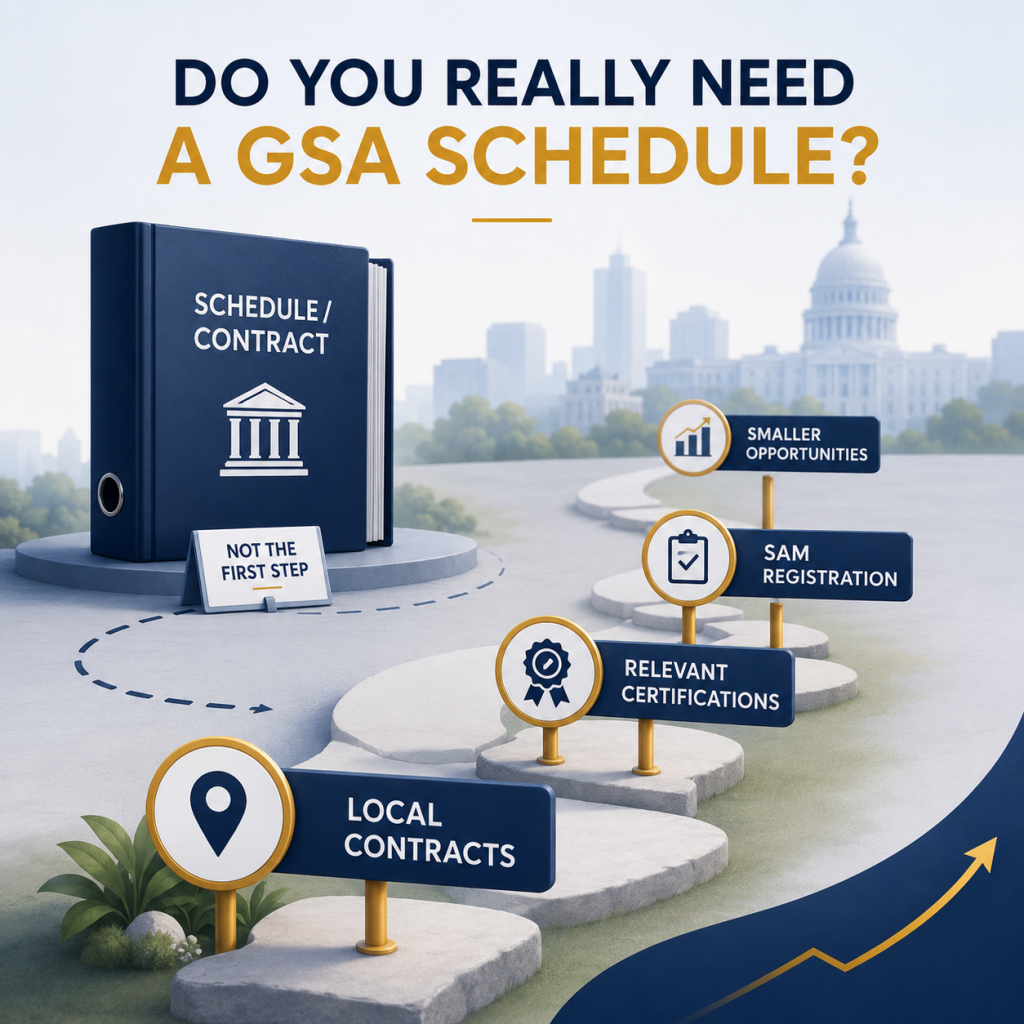
A GSA Schedule is frequently marketed to small businesses as the key to unlocking federal contracts.
Some companies are told that they need one before they can sell to the federal government. Others are encouraged to spend $5,000, $8,000, or more obtaining a Schedule before they have identified a single agency that intends to buy from them through that contract vehicle.
For many new government contractors, that is the wrong place to start.
A GSA Multiple Award Schedule can be useful—but it is not a certification, it is not a guaranteed source of leads, and it is not required to compete for most government contracts.
The GSA Multiple Award Schedule, commonly called the GSA Schedule or MAS, is a long-term governmentwide contract through which approved businesses offer commercial products and services at negotiated pricing.
Government buyers can use the Schedule to purchase from approved contractors without conducting a completely open procurement each time.
That sounds valuable—and it can be. However, the GSA Schedule is only one of many ways agencies purchase products and services.
GSA specifically states that the Schedule is not a mandatory purchasing source and that receiving a MAS contract does not guarantee government business. Contractors must still market their services, locate opportunities, compete for orders, and manage the contract after award.
Obtaining a Schedule does not mean federal buyers will begin contacting your business.
After award, the contractor is still responsible for:
GSA currently requires MAS contractors to generate at least $100,000 in sales during their first five years and $125,000 during each five-year period afterward. GSA also makes clear that the contractor’s own marketing efforts must generate those sales.
In other words, obtaining the vehicle does not create the customer.
The problem is not necessarily the Schedule itself. The problem is obtaining it before the business has developed a government sales strategy.
A company may struggle when it:
Paying someone to prepare the application does not solve these problems.
A consultant may help your company obtain the vehicle, but the consultant cannot manufacture agency demand for your services.
Before investing thousands of dollars in a GSA Schedule, answer the following questions:
When those answers reveal consistent Schedule-based purchasing activity, pursuing a MAS contract may make sense.
When they do not, your time and money may be better spent elsewhere.
For many small businesses, a better government-contracting entry strategy is to build experience through smaller and more accessible opportunities.
Pursue contracts your company can perform successfully with its current staffing, finances, equipment, and experience.
A smaller contract performed well can provide:
Your first government contract does not need to transform your company. It needs to establish that your company can perform.
State, local, and educational agencies purchase many of the same products and services as the federal government.
Cities, counties, school districts, public universities, transportation agencies, airports, housing authorities, and state departments can provide opportunities closer to your existing service area.
Local work may also allow your business to develop relationships with buyers, attend in-person meetings, and build public-sector experience without immediately competing nationwide.
Qualified businesses should evaluate federal, state, and local certification programs.
These may include:
The right certifications can help your business access restricted opportunities, support prime-contractor diversity goals, increase buyer visibility, and compete within a smaller pool of eligible firms.
Certification is not a substitute for capability, but it can help a capable business get noticed.
Most businesses should first establish:
Once that foundation begins generating opportunities, you can evaluate whether a GSA Schedule would support an existing strategy.
A Schedule may be worthwhile when:
That is very different from purchasing a Schedule because someone told you every federal contractor needs one.
Do not rely on assumptions. Research actual government purchasing behavior.
Start by identifying your company’s:
Not every federal contractor needs a GSA Multiple Award Schedule.
Do I need a GSA Schedule to bid on SAM.gov opportunities?
No. Many federal contracts are competed through SAM.gov without requiring the bidder to hold a GSA Schedule.
Does a GSA Schedule guarantee government contracts?
No. GSA expressly states that obtaining a MAS contract does not guarantee government business. The contractor must market its offerings and actively pursue orders.
Is a GSA Schedule ever valuable?
Yes. It can be valuable when agencies are already purchasing your products or services through the Schedule and your business has a realistic sales strategy.
A GSA Schedule should support a government sales strategy. It should not be the strategy.
Before paying thousands of dollars for one, determine where your business should compete, what agencies actually buy, which certifications create an advantage, and how your company will become visible to buyers.
govCERTS helps small businesses build that foundation through SAM registration, SBA profile optimization, government certifications, vendor registrations, capabilities statements, market positioning, and proposal support.
Start small. Start local. Start strategically.
| Cookie | Duration | Description |
|---|---|---|
| cookielawinfo-checkbox-analytics | 11 months | This cookie is set by GDPR Cookie Consent plugin. The cookie is used to store the user consent for the cookies in the category "Analytics". |
| cookielawinfo-checkbox-functional | 11 months | The cookie is set by GDPR cookie consent to record the user consent for the cookies in the category "Functional". |
| cookielawinfo-checkbox-necessary | 11 months | This cookie is set by GDPR Cookie Consent plugin. The cookies is used to store the user consent for the cookies in the category "Necessary". |
| cookielawinfo-checkbox-others | 11 months | This cookie is set by GDPR Cookie Consent plugin. The cookie is used to store the user consent for the cookies in the category "Other. |
| cookielawinfo-checkbox-performance | 11 months | This cookie is set by GDPR Cookie Consent plugin. The cookie is used to store the user consent for the cookies in the category "Performance". |
| viewed_cookie_policy | 11 months | The cookie is set by the GDPR Cookie Consent plugin and is used to store whether or not user has consented to the use of cookies. It does not store any personal data. |