
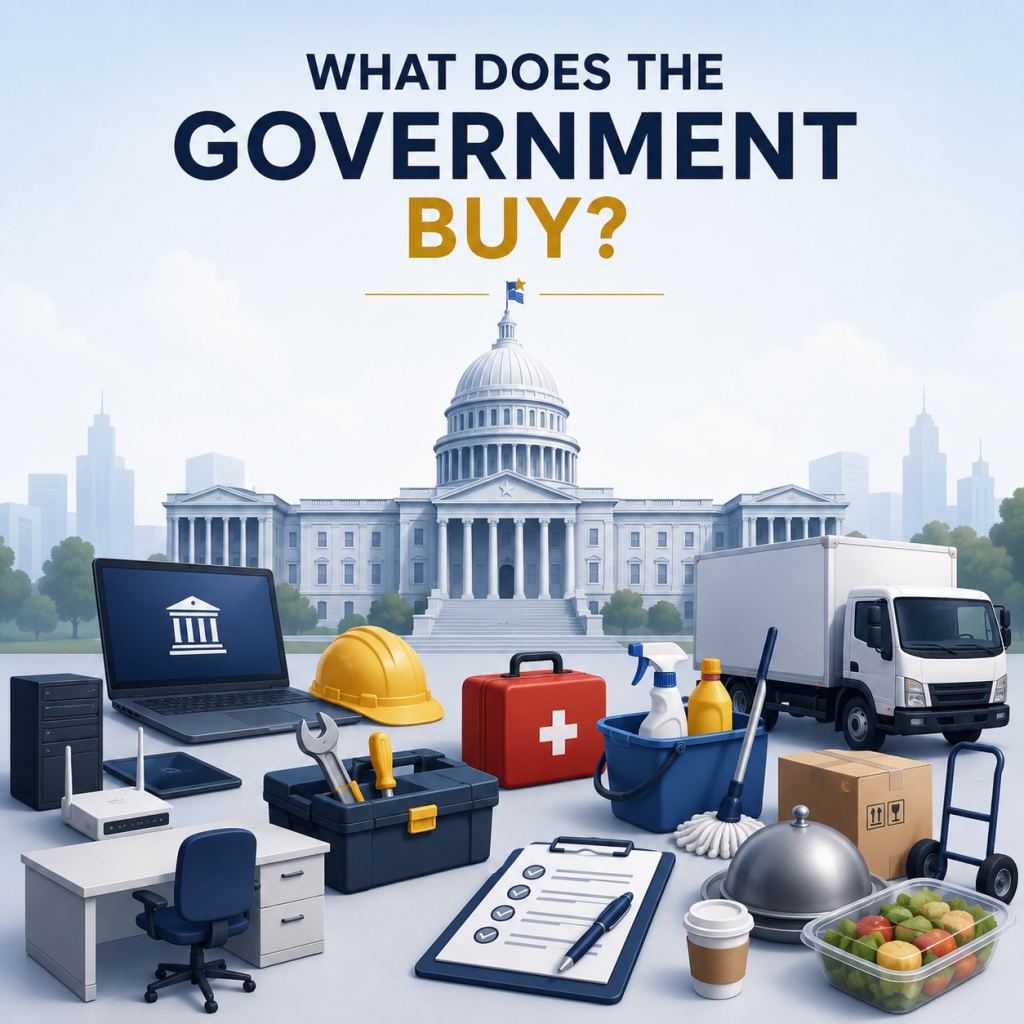
One of the most common questions small business owners ask is:
“Would the government actually buy what my company sells?”
In many cases, the answer is yes.
Government agencies operate offices, hospitals, military installations, schools, airports, parks, courthouses, laboratories, transportation systems, and public facilities. To keep those operations running, they purchase an enormous range of commercial products and professional services.
The federal government uses Product and Service Codes to identify products, services, and research and development purchased through federal contract actions. GSA purchasing programs alone give eligible government buyers access to millions of commercial products and services.
Government agencies regularly purchase professional support services, including:
A service does not need to be unusual or defense-related to have government demand. Agencies need many of the same business services purchased by private-sector organizations.
Construction represents a major portion of public-sector purchasing at every level of government.
Opportunities may include:
Small businesses can participate as prime contractors, subcontractors, suppliers, or specialty trade contractors.
State and local transportation projects can also create significant opportunities for certified Disadvantaged Business Enterprises and other small or diverse contractors.
Government buildings must be cleaned, maintained, repaired, secured, and operated.
Agencies purchase services such as:
These contracts are often recurring, making facilities-related work particularly attractive to companies seeking predictable revenue.
Government agencies depend heavily on technology vendors.
Common requirements include:
GSA’s information technology offerings include hardware, software, cloud services, cybersecurity, e-commerce, health IT, and professional IT support.
Federal, state, and local agencies purchase healthcare-related products and services for hospitals, veterans’ facilities, correctional institutions, public health departments, schools, and emergency-response operations.
Opportunities can include:
Government agencies must move people, equipment, supplies, mail, and emergency resources.
Purchases may include:
Transportation businesses may find opportunities as direct contractors or subcontractors supporting larger programs.
Government buyers also purchase:
Schools, correctional facilities, military installations, hospitals, emergency shelters, and public events can all generate food-service requirements.
The government buys ordinary products used in day-to-day operations, including:
A small business does not necessarily need to manufacture a product to participate. Depending on the procurement and applicable regulations, distributors and resellers may also compete.
Emergency events create demand for vendors that can mobilize quickly.
Government purchases may include:
Businesses interested in emergency work should complete the proper registrations before a disaster occurs. Waiting until an emergency has already been declared can cause the company to miss early purchasing activity.
Do not rely on assumptions. Research actual government purchasing behavior.
Start by identifying your company’s:
SAM.gov allows businesses to search federal contract opportunities, follow notices, save searches, and review award data.
Not every federal contractor needs a GSA Multiple Award Schedule.
A GSA Schedule is one purchasing vehicle used by government buyers, but many contracts are competed through SAM.gov, agency-specific systems, simplified purchasing procedures, subcontracting relationships, and other contract vehicles.
Before pursuing a GSA Schedule, determine whether your target agencies actually use that vehicle to purchase what your company sells.
Do I need a SAM registration for state or local contracts?
Usually not. SAM.gov is primarily used for federal awards. State and local agencies generally maintain their own vendor registration and procurement systems.
Can my business pursue SLED and federal contracts at the same time?
Yes. Many companies pursue local, state, and federal opportunities simultaneously, provided they have the resources to manage the registrations, bids, and resulting contracts.
Is a government certification required to win contracts?
Not always. Businesses can win many openly competed contracts without a socioeconomic certification. However, the right certification may create access to restricted opportunities, subcontracting programs, purchasing preferences, and buyer outreach.
Before investing time in registrations and certifications, determine which market offers the best opportunities for your company.
govCERTS can assess your industry, location, ownership, service area, and contracting goals to help identify the most valuable SLED and federal pathways for your business.
Get Certified. Get Positioned. Start Competing.
| Cookie | Duration | Description |
|---|---|---|
| cookielawinfo-checkbox-analytics | 11 months | This cookie is set by GDPR Cookie Consent plugin. The cookie is used to store the user consent for the cookies in the category "Analytics". |
| cookielawinfo-checkbox-functional | 11 months | The cookie is set by GDPR cookie consent to record the user consent for the cookies in the category "Functional". |
| cookielawinfo-checkbox-necessary | 11 months | This cookie is set by GDPR Cookie Consent plugin. The cookies is used to store the user consent for the cookies in the category "Necessary". |
| cookielawinfo-checkbox-others | 11 months | This cookie is set by GDPR Cookie Consent plugin. The cookie is used to store the user consent for the cookies in the category "Other. |
| cookielawinfo-checkbox-performance | 11 months | This cookie is set by GDPR Cookie Consent plugin. The cookie is used to store the user consent for the cookies in the category "Performance". |
| viewed_cookie_policy | 11 months | The cookie is set by the GDPR Cookie Consent plugin and is used to store whether or not user has consented to the use of cookies. It does not store any personal data. |