
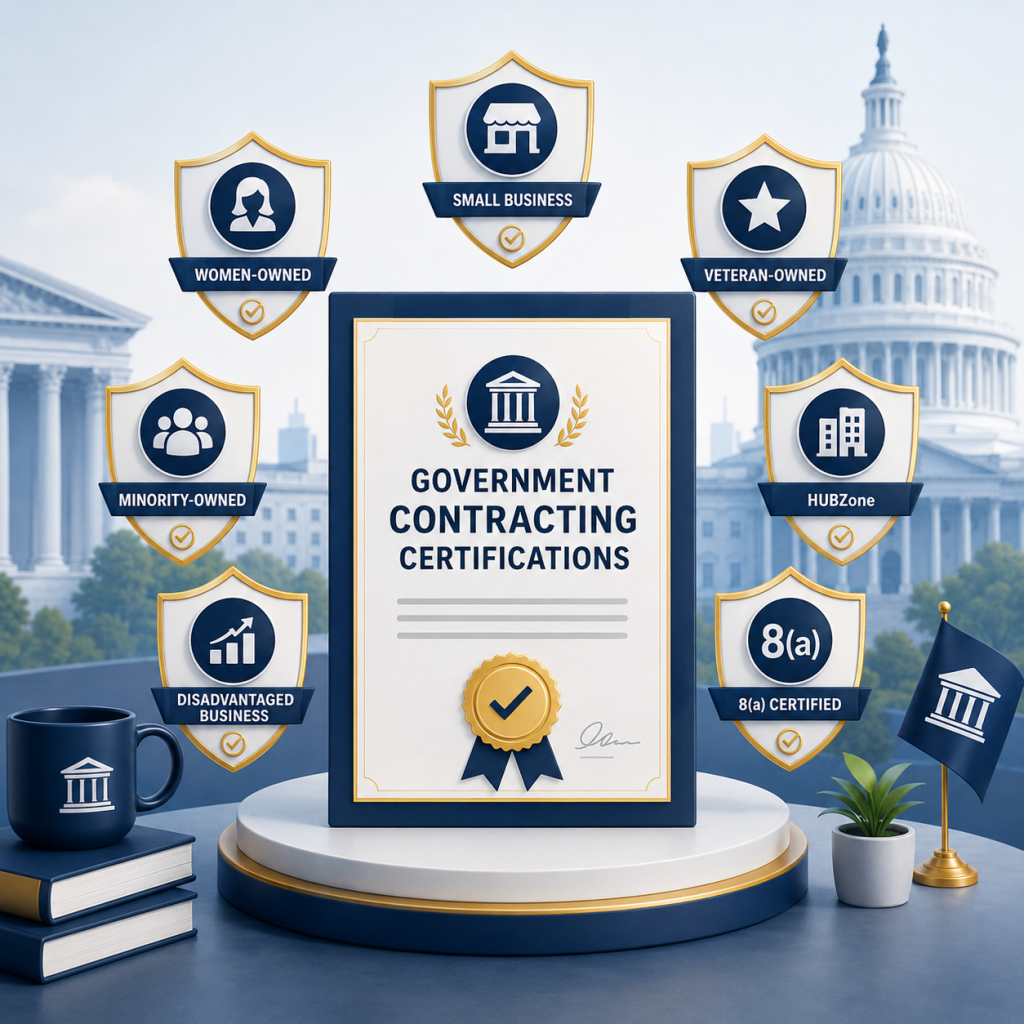
Government certifications can give qualified small businesses a valuable advantage in the public-sector marketplace.
Depending on the program, certification may help a business compete for set-aside contracts, receive purchasing preferences, become more visible to government buyers, or participate as a subcontractor on larger projects.
However, not every certification works in every marketplace. State and local certifications are separate from federal certifications, and eligibility rules can vary significantly.
A government contracting certification verifies that a business meets the requirements of a particular small-business or socioeconomic program.
Requirements may be based on:
Certification does not guarantee a contract. It creates eligibility and positioning that the business must actively use.
SLED certifications are used in the state, local, and educational marketplace.
There is no single nationwide SLED certification accepted by every agency. Each state, city, county, transportation authority, school district, or other organization may establish its own programs and eligibility requirements.
An LSBE, or Local Small Business Enterprise, certification is generally designed for small companies operating within a particular city, county, or region.
Depending on the jurisdiction, benefits may include:
Local-presence requirements vary. A mailing address or virtual office may not be sufficient when the program requires a genuine principal office or established business operation within the jurisdiction.
An SBE, or Small Business Enterprise, certification is generally based on the company’s size.
The certifying authority may consider annual revenue, number of employees, industry, location, or other criteria. Some programs are open to any qualifying small business, regardless of the owner’s race, ethnicity, gender, or veteran status.
SBE certification can be especially useful for businesses that do not qualify for an ownership-based diversity program.
An MBE, or Minority Business Enterprise, certification is generally available to businesses that are at least 51% owned, controlled, and managed by qualifying minority individuals.
Specific definitions, documentation requirements, size limits, and benefits vary by certifying authority.
Potential benefits may include inclusion in MBE directories, access to restricted opportunities, subcontracting participation, buyer outreach, and purchasing goals established by state or local agencies.
A WBE, or Women Business Enterprise, certification is generally designed for businesses that are at least 51% owned, managed, and controlled by one or more women.
Some agencies combine minority-owned and woman-owned programs under the term MWBE. Others issue separate MBE and WBE certifications.
A SLED WBE certification is different from the federal WOSB certification. A company may need both when pursuing opportunities across multiple levels of government.
The Disadvantaged Business Enterprise, or DBE, program is focused on contracts receiving financial assistance from the U.S. Department of Transportation.
DBE firms may participate in projects involving highways, bridges, airports, transit systems, public transportation, and other DOT-assisted infrastructure.
A DBE must generally be a qualifying small, for-profit business that is at least 51% owned and controlled by one or more socially and economically disadvantaged individuals. The program is administered through state Unified Certification Programs, subject to federal DOT rules.
Because DBE rules and reevaluation procedures have undergone recent changes, applicants and certified firms should confirm current requirements with their state’s Unified Certification Program.
Federal contracting certifications are primarily administered through the U.S. Small Business Administration.
SBA currently directs applicants for WOSB, EDWOSB, VOSB, SDVOSB, HUBZone, and 8(a) certifications through MySBA Certifications.
The Women-Owned Small Business, or WOSB, program allows certified businesses to compete for certain federal contracts restricted to WOSB participants.
These set-asides are used in eligible industries where women-owned small businesses are underrepresented. The federal government maintains a goal of awarding at least 5% of federal contracting dollars to women-owned small businesses.
The EDWOSB program is a category within the WOSB Federal Contract Program for businesses owned and controlled by women who also meet applicable economic-disadvantage requirements.
Some eligible federal contracts may be restricted specifically to EDWOSB firms.
The Veteran-Owned Small Business, or VOSB, certification creates additional contracting opportunities within the Department of Veterans Affairs.
Certified VOSBs may be eligible to compete for VA sole-source and set-aside contracts under the Vets First program.
The SDVOSB program is available to qualifying businesses owned and controlled by service-disabled veterans.
Certified SDVOSBs can compete for restricted and sole-source opportunities throughout the federal government. The federal government currently aims to award at least 5% of federal contracting dollars to SDVOSBs.
The Historically Underutilized Business Zone, or HUBZone, program is based primarily on business and employee location rather than minority, gender, or veteran ownership.
A qualifying business generally must maintain its principal office in a designated HUBZone and have at least 35% of its employees residing in a HUBZone.
Certified firms may compete for HUBZone set-asides and receive a 10% price evaluation preference in qualifying full-and-open competitions.
The 8(a) Business Development Program is a nine-year federal program for experienced small businesses owned and controlled by socially and economically disadvantaged individuals.
Benefits can include:
The program is intended to develop qualifying firms, not merely place them in a contracting category. Participation is generally limited to one nine-year term, and continued eligibility must be maintained.
The exact benefits depend on the program, but certification may provide:
Some opportunities are limited to businesses holding a specific certification. This reduces the eligible competition pool.
Certain federal programs permit contracting officers to award qualifying contracts without a full open competition when regulatory conditions are met.
Some SLED programs provide evaluation points, price preferences, or other advantages to certified vendors. HUBZone firms may receive a federal price evaluation preference in qualifying competitions.
Large prime contractors may have small-business or diversity subcontracting requirements and frequently search certification directories for potential partners.
Federal contracting officers use the SBA’s Small Business Search as part of market research. A complete profile can help buyers evaluate whether enough qualified small businesses exist to support a set-aside.
Certifying agencies may offer matchmaking events, technical assistance, training, vendor outreach, and introductions to purchasing officials.
A company holding complementary federal, state, local, and private-sector certifications can pursue direct contracts and subcontracting relationships across several markets.
Certification creates eligibility. It does not create demand, replace past performance, or guarantee that your pricing and proposal will be competitive.
To use a certification effectively, your business should also:
Can my business hold more than one certification?
Yes. A business may qualify for several programs, such as WOSB, EDWOSB, HUBZone, 8(a), MBE, WBE, SBE, or DBE. Each program has separate eligibility requirements.
Are state certifications accepted by the federal government?
Not automatically. A state WBE or MBE certification does not replace an SBA federal certification.
How long does certification last?
Certification and renewal periods vary. Some programs require annual updates, periodic recertification, or continuing eligibility reviews. Many, however, are 3-5 year programs.
Does certification guarantee government contracts?
No. Certification may improve access and positioning, but the business must still identify opportunities, meet solicitation requirements, demonstrate capability, and compete successfully.
Applying for every available program is rarely the best strategy.
The most valuable certifications are those used by agencies and prime contractors that purchase your company’s products or services.
govCERTS evaluates your ownership, business location, industry, service area, and government-contracting goals to identify applicable SLED and federal programs. We then assist with the documentation, application preparation, submission, and post-certification positioning needed to put those credentials to work.
Do not pursue certification just to obtain a certificate. Pursue certification with a plan to generate opportunities.
| Cookie | Duration | Description |
|---|---|---|
| cookielawinfo-checkbox-analytics | 11 months | This cookie is set by GDPR Cookie Consent plugin. The cookie is used to store the user consent for the cookies in the category "Analytics". |
| cookielawinfo-checkbox-functional | 11 months | The cookie is set by GDPR cookie consent to record the user consent for the cookies in the category "Functional". |
| cookielawinfo-checkbox-necessary | 11 months | This cookie is set by GDPR Cookie Consent plugin. The cookies is used to store the user consent for the cookies in the category "Necessary". |
| cookielawinfo-checkbox-others | 11 months | This cookie is set by GDPR Cookie Consent plugin. The cookie is used to store the user consent for the cookies in the category "Other. |
| cookielawinfo-checkbox-performance | 11 months | This cookie is set by GDPR Cookie Consent plugin. The cookie is used to store the user consent for the cookies in the category "Performance". |
| viewed_cookie_policy | 11 months | The cookie is set by the GDPR Cookie Consent plugin and is used to store whether or not user has consented to the use of cookies. It does not store any personal data. |