
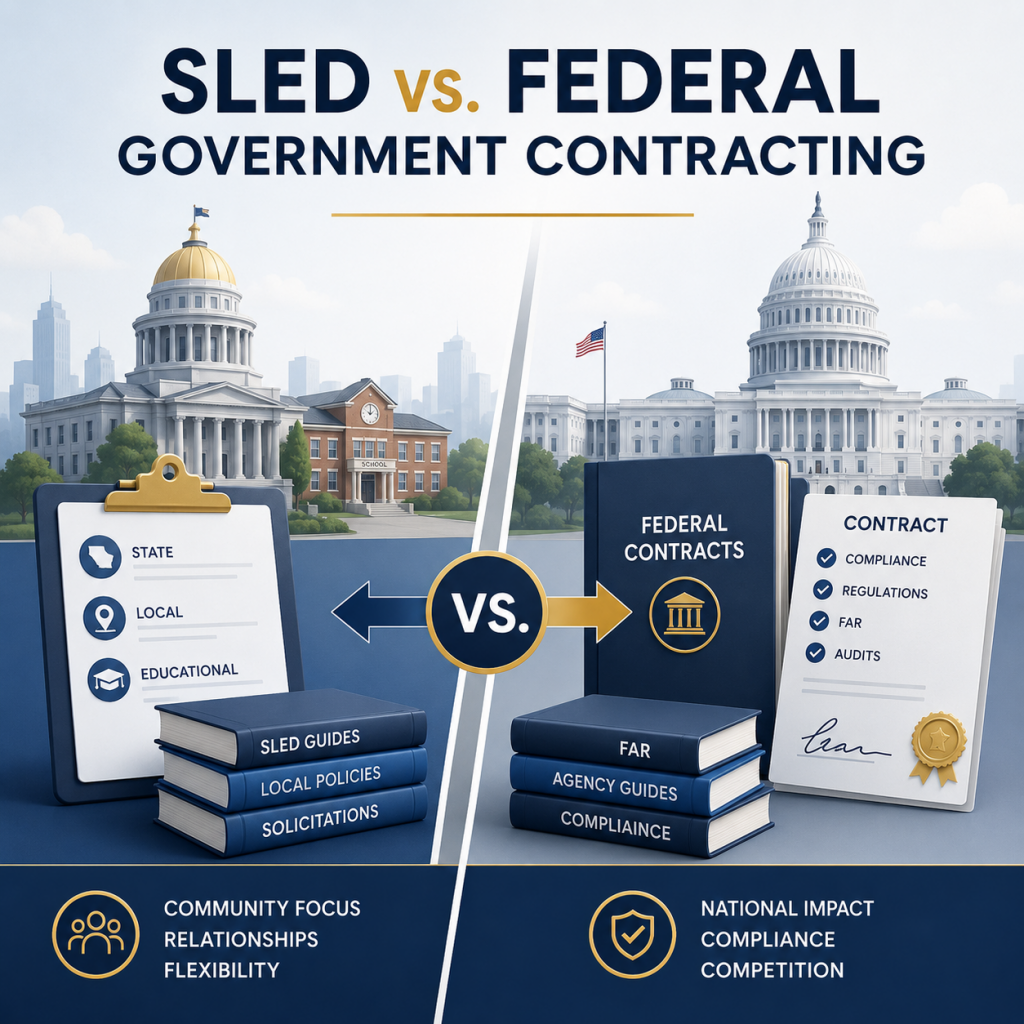
Government contracting is not one single marketplace. Small businesses can sell to federal agencies, state governments, counties, cities, school districts, public universities, transportation authorities, and thousands of other government organizations.
These opportunities generally fall into two major categories: SLED contracting and federal contracting.
While both markets can generate long-term business, they use different registration systems, certifications, purchasing rules, and bidding processes. Understanding those differences can help you determine where your company should focus first.
SLED stands for:
The SLED marketplace includes state agencies, counties, cities, school districts, public colleges and universities, housing authorities, airports, transportation agencies, utility authorities, and other local government organizations.
Examples of SLED buyers include a state Department of Transportation, a county public works department, a city police department, a school district, or a public university.
Unlike the federal government, SLED does not operate through one universal vendor registration or bidding platform. A business may need to register separately with its state, county, city, school district, or another purchasing organization.
Requirements also vary significantly by location. One city may have a Local Small Business Enterprise program, while another may offer MBE, WBE, SBE, veteran-owned, or other certification programs.
Federal contracting involves selling products or services to departments and agencies of the United States government.
Federal buyers include organizations such as the Department of Defense, Department of Veterans Affairs, Department of Homeland Security, General Services Administration, Department of Transportation, and hundreds of other agencies and offices.
Businesses seeking direct federal contract awards generally need an active registration in the System for Award Management, commonly known as SAM.gov. Registration provides the business with a Unique Entity ID and allows it to represent its size and socioeconomic status. SAM registrations must generally be renewed every 365 days to remain active.
Federal contracting is governed primarily by the Federal Acquisition Regulation, along with agency-specific supplements and solicitation requirements.
Lorem ipsum dolor sit amet, consectetur adipiscing elit. Ut elit tellus, luctus nec ullamcorper mattis, pulvinar dapibus leo.
Neither market is automatically easy, but SLED opportunities can offer a practical entry point for some small businesses.
A local government may prefer vendors that can respond quickly, provide on-site service, maintain required local licensing, or demonstrate knowledge of the community. Smaller contracts may also give a newer contractor an opportunity to build government past performance.
Federal opportunities can be larger and more standardized, but they may involve additional compliance requirements, more formal proposal instructions, and stronger competition.
The right starting point depends on:
A common mistake is assuming that one certification applies everywhere.
A federal WOSB certification does not automatically make a company a certified WBE with a city or state. Likewise, a state MBE certification does not automatically qualify a business for the SBA’s 8(a) Business Development Program.
SLED certifications are generally issued by individual states, municipalities, transportation agencies, or other certifying authorities. Federal certifications are generally administered through the SBA’s certification systems.
Your business may qualify for certifications in both markets, but each application must be evaluated separately.
SLED contracting may be a strong fit when:
Federal contracting may be a strong fit when:
Many successful government contractors pursue both. A company might perform directly for cities and school districts, subcontract on state projects, and simultaneously develop relationships with federal buyers.
More registrations do not automatically create more revenue.
A better approach is to identify which agencies purchase your products or services, research their previous awards, determine how they advertise opportunities, and pursue only the registrations and certifications that support that strategy.
govCERTS assists small businesses with SLED certifications, federal certifications, SAM registration, SBA profile optimization, state vendor registrations, capabilities statements, and proposal writing. The goal is not simply to place your company in another database—it is to position your business to find, pursue, and compete for the right opportunities.
Do I need a SAM registration for state or local contracts?
Usually not. SAM.gov is primarily used for federal awards. State and local agencies generally maintain their own vendor registration and procurement systems.
Can my business pursue SLED and federal contracts at the same time?
Yes. Many companies pursue local, state, and federal opportunities simultaneously, provided they have the resources to manage the registrations, bids, and resulting contracts.
Is a government certification required to win contracts?
Not always. Businesses can win many openly competed contracts without a socioeconomic certification. However, the right certification may create access to restricted opportunities, subcontracting programs, purchasing preferences, and buyer outreach.
Before investing time in registrations and certifications, determine which market offers the best opportunities for your company.
govCERTS can assess your industry, location, ownership, service area, and contracting goals to help identify the most valuable SLED and federal pathways for your business.
Get Certified. Get Positioned. Start Competing.
| Cookie | Duration | Description |
|---|---|---|
| cookielawinfo-checkbox-analytics | 11 months | This cookie is set by GDPR Cookie Consent plugin. The cookie is used to store the user consent for the cookies in the category "Analytics". |
| cookielawinfo-checkbox-functional | 11 months | The cookie is set by GDPR cookie consent to record the user consent for the cookies in the category "Functional". |
| cookielawinfo-checkbox-necessary | 11 months | This cookie is set by GDPR Cookie Consent plugin. The cookies is used to store the user consent for the cookies in the category "Necessary". |
| cookielawinfo-checkbox-others | 11 months | This cookie is set by GDPR Cookie Consent plugin. The cookie is used to store the user consent for the cookies in the category "Other. |
| cookielawinfo-checkbox-performance | 11 months | This cookie is set by GDPR Cookie Consent plugin. The cookie is used to store the user consent for the cookies in the category "Performance". |
| viewed_cookie_policy | 11 months | The cookie is set by the GDPR Cookie Consent plugin and is used to store whether or not user has consented to the use of cookies. It does not store any personal data. |